The future of repair · the long-term horizon

Where repair is heading. And how you get there in steps.

Automation is reaching the service floor one task at a time. Robots already change tyres, plug in charging cables and repair bumpers, and AI is learning from real service work. You do not need to bet on it today: businesses that document their work now, step by step, are ready when these tools make sense for them. Physical AI is milestone 5 of the AMPS roadmap, delivered with partners.

The future bay · interactive concept

Electric vehicles. Intelligent service bays.

A visual direction for robot-assisted wheel service: one repeatable task, in one validated cell, with a technician in control. Not a claim of an available AMPS robotics service.
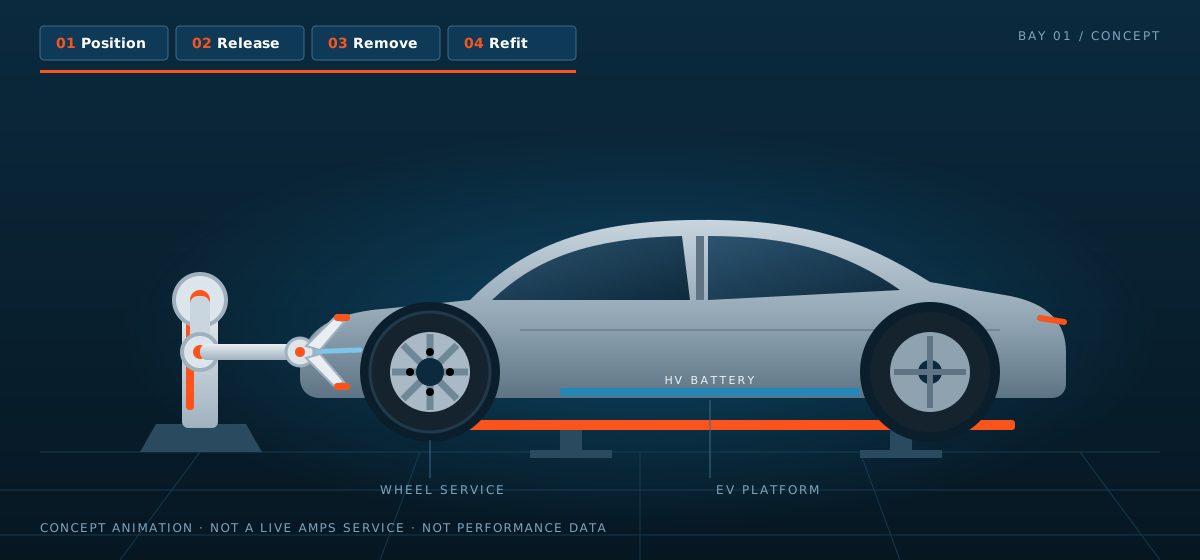
Concept animation: a robot arm positions, releases, removes and refits the front wheel of an electric vehicle on a lift
01 · Start with expertiseReal work. Real context.The programme starts with the service and repair work that matters to your operation.
02 · Build useful knowledgeDocument the process.Structured records reveal methods, quality checks and where automation could help.
03 · Validate the next stepAutomate with purpose.Specific tasks are piloted with partners, each with a defined business case and safety assessment.
Concept animation. Any deployment depends on technical validation, safety assessment, partners and the agreed programme scope. Status: long-term vision.
Beyond the factory

Physical AI is spreading to every skilled task.

AP describes physical AI as machines with AI and sensors that perceive, decide and act in real-world environments. Wherever work depends on perception, hand-eye coordination and judgement, physical AI needs real-world data to learn from. It is moving from factory floors into the field and emergency response. Automotive repair, maintenance and service is next.

PerceptionSeeing the taskRecognising parts, tools, damage and condition, as a skilled person does.
Hand-eye coordinationMoving with precisionGrip, angle, force and sequence, learned from real demonstrations.
JudgementDeciding what to doChoosing the next step, checking the result and handling the unexpected.
WorkplacesSouth Korea · May 2026
Skilled motions recorded to build robot "brains" RLWRLD fits workers with head, chest and hand cameras. Their motions, including joint angles and force, feed a database that trains robots. AP calls this physical AI: machines that perceive, decide and act in the real world. Source: AP via WTOP ↗
Field roboticsUnited States · Sep 2026
Robots that keep learning after deployment Skylark Labs, with researchers from Carnegie Mellon and UC Berkeley, developed Continual Field-Adaptive Models. Manipulators, humanoids, quadrupeds, drones and off-road vehicles keep learning from real-world experience without retraining their core models. Source: Robotics & Automation News ↗
Emergency responseUnited States · Research
Robot fleets that find and assess casualties In the DARPA Triage Challenge, university teams such as the University of Pennsylvania build ground and aerial robots that locate and assess casualties for first responders, under real-world conditions. Source: University of Pennsylvania ↗

Where AMPS comes in: AMPS captures this kind of data in automotive service operations, during real repair, maintenance and service work, then anonymises and structures it so physical-AI models can learn skilled repair.

Where repair is heading

Three stages towards the robot-assisted service site.

This is the AMPS view of how automation will reach vehicle maintenance. It is our expectation, not a promise or a date. Each stage builds on data from the one before.

Stage 1 · Now Assisted and narrow automation Robots take single, well-defined tasks; AI supports diagnosis. Skilled technicians do the repair.
→Tyre and wheel robots→Charging robots→AI-supported diagnostics
Stage 2 · Next Robots learn from recorded repairs Models trained on video and motion data of real repairs begin to assist with repetitive service tasks.
→Learning from demonstration→Service and fast-fit tasks first→Technicians supervise
Stage 3 · Future The robot-assisted service floor Robots handle a growing share of standard maintenance; technicians lead diagnosis, quality and complex repair.
→Broader task coverage→Human-robot teams→Data-driven repair standards
Repair robotics today

Robots are already working on vehicles.

Physical AI already handles narrow, well-defined jobs on vehicles: wheels, charging, bumper repair and AI-supported diagnostics. Each one shows where broader repair automation can start.

How robots learn manual skills

They watch skilled hands, then practise.

Manual work is hard to program step by step. Increasingly, robots learn it from demonstration instead: video and motion data of a skilled person doing the task, turned into a model that predicts the right movement in each situation. The quality and variety of those demonstrations decide how well the robot performs.

01 MovementHow hands and tools move: grip, angle, force, sequence.
02 PerspectiveFirst-person video showing what the technician sees.
03 TimingHow long each step takes in real conditions.
04 ContextWhich vehicle, which fault, which decision, which check.
Already happening Germany · Jul 2026 ↗ Tesla records Grünheide workers to train Optimus Cameras capture how employees grip tools, handle parts and carry out steps. (electrive, citing Handelsblatt) Germany · Jul 2026 ↗ Audi robots learn dexterous tasks from video Mimic Robotics’ video-action model learns work such as car-door assembly from demonstrations. (Robotics 24/7) Germany · Feb 2026 ↗ BMW brings humanoid robots to its Leipzig plant After a Figure 02 humanoid supported production of 30,000+ BMW X3s in the US, BMW is piloting humanoids in Germany. (BMW Group) South Korea · May 2026 ↗ Workers wear head, chest and hand cameras to teach robots RLWRLD records skilled staff at work and turns their motions, including joint angles and force, into robot training data. (AP via WTOP)
The missing ingredient

Factories record their work. Service sites don't, yet.

A car factory repeats the same steps on the same model thousands of times. A service bay sees a different vehicle, fault and condition in every bay. That variety is exactly what a repair robot must learn, and it is rarely recorded anywhere.

The gap Every vehicle is different Brands, models, ages and conditions vary in every bay. Robots must learn that variety.
What AMPS captures Repairs recorded across brands, repair areas and service sites.
The gap Know-how lives in people How an experienced technician approaches a job is rarely written down.
What AMPS captures First-person video of hand-eye coordination and key decisions.
The gap Privacy is non-negotiable Service footage contains people, plates and customer details.
What AMPS captures Data anonymised before processing, with clients informed upfront.
Which repair tasks come first

Not every job automates at the same pace.

Our view on how the main repair areas line up for automation. The more repetitive and standardised the task, the sooner robots can assist. The more judgement it needs, the longer people lead and AI advises.

Repair areaAutomation outlookLikely first stepData that helps most
Tyres & fast-fit Early Wheel removal, lifting and fitting Wheel handling, cycle times
EV & high-voltage Early (charging) Automated charging connection Safety routines, battery handling
Service & maintenance Emerging Repetitive service steps Task sequences, tool handling, timing
Body, paint & smart repair Research Defined repairs such as bumpers Fine-motor technique, surface prep
Diagnostics & ADAS AI-assisted AI suggests, technician decides Fault-tracing paths, decision points
Truck, bus & heavy Longer term Assisted handling of heavy parts Heavy-part handling, multi-person flows
Outlook reflects AMPS's assessment, not a prediction with fixed timelines.
People and robots

Robots take the strain. Technicians keep the judgement.

In the deployments that exist today, robots take on the heavy, repetitive part of a job while technicians operate them and handle the rest. We expect the future of vehicle service to work the same way: robots for repetition and load, people for diagnosis, quality and the unexpected.

RobotsRepetitionThe same movement, many times a day.
RobotsPhysical loadLifting wheels, holding heavy parts.
TechniciansDiagnosisFinding the real cause of a fault.
TechniciansQuality & exceptionsChecking the result and handling the unexpected.
Start today, at milestone 1

Digital today. Autonomous tomorrow.

The road to automation starts with a tablet. An AMPS programme takes care of today’s work, documents the work and builds, step by step, the insight and readiness your service operation needs for what comes next.

Request a programme proposal → Automation or AI partner? Talk to us → Links on this page lead to independent sources. AMPS is not affiliated with the companies and institutes mentioned.
Future of Repair: AI, Automation and Robotics | AMPS
The future of repair · the long-term horizon

Where repair is heading. And how you get there in steps.

Automation is reaching the service floor one task at a time. Robots already change tyres, plug in charging cables and repair bumpers, and AI is learning from real service work. You do not need to bet on it today: businesses that document their work now, step by step, are ready when these tools make sense for them. Physical AI is milestone 5 of the AMPS roadmap, delivered with partners.

How robots learn repair → The AMPS programme →
The future bay · interactive concept

Electric vehicles. Intelligent service bays.

A visual direction for robot-assisted wheel service: one repeatable task, in one validated cell, with a technician in control. Not a claim of an available AMPS robotics service.

Concept animation: a robot arm positions, releases, removes and refits the front wheel of an electric vehicle on a lift
01 · Start with expertiseReal work. Real context.The programme starts with the service and repair work that matters to your operation.
02 · Build useful knowledgeDocument the process.Structured records reveal methods, quality checks and where automation could help.
03 · Validate the next stepAutomate with purpose.Specific tasks are piloted with partners, each with a defined business case and safety assessment.
Concept animation. Any deployment depends on technical validation, safety assessment, partners and the agreed programme scope. Status: long-term vision.
Beyond the factory

Physical AI is spreading to every skilled task.

AP describes physical AI as machines with AI and sensors that perceive, decide and act in real-world environments. Wherever work depends on perception, hand-eye coordination and judgement, physical AI needs real-world data to learn from. It is moving from factory floors into the field and emergency response. Automotive repair, maintenance and service is next.

{{ nd.k }}{{ nd.t }}{{ nd.d }}
{{ n.task }}{{ n.where }}
{{ n.t }} {{ n.d }} Source: {{ n.src }} ↗

Where AMPS comes in: AMPS captures this kind of data in automotive service operations, during real repair, maintenance and service work, then anonymises and structures it so physical-AI models can learn skilled repair.

Where repair is heading

Three stages towards the robot-assisted service site.

This is the AMPS view of how automation will reach vehicle maintenance. It is our expectation, not a promise or a date. Each stage builds on data from the one before.

{{ st.k }} {{ st.t }} {{ st.d }}
→{{ x }}
Repair robotics today

Robots are already working on vehicles.

Physical AI already handles narrow, well-defined jobs on vehicles: wheels, charging, bumper repair and AI-supported diagnostics. Each one shows where broader repair automation can start.

{{ n.task }}{{ n.where }}
{{ n.t }} {{ n.d }} Source: {{ n.src }} ↗
How robots learn manual skills

They watch skilled hands, then practise.

Manual work is hard to program step by step. Increasingly, robots learn it from demonstration instead: video and motion data of a skilled person doing the task, turned into a model that predicts the right movement in each situation. The quality and variety of those demonstrations decide how well the robot performs.

{{ p.n }} {{ p.t }}{{ p.d }}
Already happening {{ n.where }} · {{ n.date }} ↗ {{ n.t }} {{ n.d }} ({{ n.src }})
The missing ingredient

Factories record their work. Service sites don't, yet.

A car factory repeats the same steps on the same model thousands of times. A service bay sees a different vehicle, fault and condition in every bay. That variety is exactly what a repair robot must learn, and it is rarely recorded anywhere.

The gap {{ r.p }} {{ r.pd }}
What AMPS captures {{ r.a }}
Which repair tasks come first

Not every job automates at the same pace.

Our view on how the main repair areas line up for automation. The more repetitive and standardised the task, the sooner robots can assist. The more judgement it needs, the longer people lead and AI advises.

Repair areaAutomation outlookLikely first stepData that helps most
{{ r.a }} {{ r.o }} {{ r.f }} {{ r.d }}
Outlook reflects AMPS's assessment, not a prediction with fixed timelines.
People and robots

Robots take the strain. Technicians keep the judgement.

In the deployments that exist today, robots take on the heavy, repetitive part of a job while technicians operate them and handle the rest. We expect the future of vehicle service to work the same way: robots for repetition and load, people for diagnosis, quality and the unexpected.

{{ p.k }}{{ p.t }}{{ p.d }}
Start today, at milestone 1

Digital today. Autonomous tomorrow.

The road to automation starts with a tablet. An AMPS programme takes care of today’s work, documents the work and builds, step by step, the insight and readiness your service operation needs for what comes next.

Request a programme proposal → Automation or AI partner? Talk to us → Links on this page lead to independent sources. AMPS is not affiliated with the companies and institutes mentioned.